Wednesday, April 24, 2013
Say Hello to Inner Waves Organics!

About Inner Waves Organics:
At Inner Waves Organics we work hard to do the right thing for our customers, our community and our world. We have been blessed with the opportunity to see, with great clarity, the precious nature of life and the impact that each of us can make through compassionate living and conscious choices. The mission of Inner Waves is to reinforce these ideals through our business.
We design and produce our exceptional organic clothing with great care in the USA. We use the finest organic and sustainable fibers and the most environmentally responsible production processes available. We create our clothing to move with the rhythm of our practice and our lives.
Inner Waves is a business that strives to share our passion for design, movement and beauty with our compassion for our community and our planet. We hope our yoga clothing inspires you as it does us.
See the Inner Waves Organics Womens Clothes Here:


CHOOSING ORGANIC
Organic Yoga Clothing supports your practice... on and off the mat. Through Inner Waves Organics exclusive use of fine organic cottons, environmentally safe dyes and responsible production practices, we work to restore harmony by protecting our soil, air and water and uplifting our community.
ORGANIC COTTON
DEFINITION: Organic cotton is grown and harvested without being sprayed with harmful pesticides, fungicides, herbicides or chemical fertilizers.
RESULT OF USE: This helps save our water, soil and overall environment. Organic practices help reduce the cause of serious health issues and provides a livelier place for us and future generations to live.
FACTS
You may be surprised to learn that conventionally grown cotton is one of the earth's most heavily sprayed crops and is one of the greatest users of synthetic fertilizers. In fact, the cotton in an average conventional (non-organic) T-shirt may have been produced using: 7 tsps synthetic fertilizers, 3/4 tsp of other active ingredients; pesticides, herbicides, insecticides, and defoliants
Average acre of California grown cotton:
200 lbs nitrogen
60 lbs phosphorous
40 lbs potash
46% of all U.S. counties contain groundwater that is susceptible to contamination by agricultural pesticides and fertilizers.
14 MILLION people in the U.S. may be exposed to herbicides through contaminated drinking water.
FARM WORKERS have the highest rate of chemical-related illness of any occupational group in the U.S.
MAJOR EFFECTS OF CONVENTIONALLY GROWN COTTON
Contamination of ground water, polluting wells and drinking water
Sterilization of soil
Air contamination
All three creating serious health problems
GOOD REASONS TO BUY ORGANIC COTTON
Reduces the market for products made with harsh chemicals that can harm the earth, air and water
Supports conscious living choices
Fabric is soft and durable
Supports local and smaller farm industries
Conventional cotton is the second most heavily sprayed crop and fourth heaviest user of synthetic fertilizer
POSITIVE ALTERNATIVES FOR A SUSTAINABLE FUTURE
Buy ORGANICALLY GROWN COTTON or other Sustainable fibers:• Hemp • Tencel • Bamboo
STEPS TO INITIATE PARTICIPATION
Start by buying a few primary pieces of clothing that you use often and or close to your skin
Spread the word and learn more
Go beyond, extending your earth-healthy choices to organic foods, responsible products, and a sustainable lifestyle
Now is the time to educate ourselves about Organic Cotton and the role it plays for us all and our planet. As we learn how our choices effect the earth, our environment and our communities we take a step toward being even better stewards.
"The principal guidelines for organic production are to use materials and practices that enhance the ecological balance of natural systems that integrate the parts of the farming system into an ecological whole" *
- info from OTA, The Organic Trade Association is the leading business association representing the organic industry in the United States, Canada, and Mexico.

Monday, April 22, 2013
Welcome Jules our newest Brand Ambassador!


Growing up, I remember having a few things that I loved above all else...traveling (I was an Air Force brat whose parents believed in seeing the world), movement (I dreamed of being a prima ballerina), teaching (my younger brothers might call me bossy), and playing dress up (I had a chest full of costuming). As it turns out, growing older and finding my place in the world hasn't taken me very far from those beginnings at all. Hi, my name is Julia, or Jules to many, and I am a yoga teacher and a full time road rennie.
A what, you ask? A road rennie. That's my term for myself anyway. My partner and I work full time at renaissance festivals around the country, so we lead a nomadic life, picking up and moving every two months or so to the next festival on our circuit. We're part of an expansive and often far-flung community of artisans, performers, crafters, and shop workers of all sorts who work in some capacity at one or more of the forty-something major renaissance festivals that take place across the country each year. My "uniform" consists of bloomers, multiple skirts, a chemise, and a fully boned bodice.
I also teach yoga within the rennie community, leading practice on an empty stage or in a shop a few times each week. In many ways, the practice I lead is similar to those taking place in studios in towns and cities all over the place. I lead my fellow yogis through asana and pranayama and meditation and intention. In many ways, however, rennie yogis face a unique set of challenges every time we roll out our mats. Mainly because being outside without the protection of four walls and climate control makes for some pretty interesting practices.
I'll tell those stories another time, though. For now, I'd like to focus on the travel aspect of my not-quite-normal life (I always thought "normal" to mean "boring," anyway). Like I said, every two months my partner, A, and I wrap up the breakables, pack up the yard, hitch the trailer (aka our house on wheels) up to the truck, and drive to the next festival. The most recent version of this happened just a week ago when we moved from Arizona to Texas.
For most of our transitions, we have at least one weekend off and several days to make our trek. Our springtime journey from the Phoenix area to just south of Dallas every year is the exception to that rule, and a stressful one at that. It goes something like this...closing weekend of the Arizona Renaissance Festival on Saturday & Sunday; Monday-Friday to pack up, etc., drive 1000+ miles, reset everything back into place, opening weekend of Scarborough Renaissance Festival that very next weekend. I call it a five-day mad dash, and there's really nothing about it that I like.
Under the best circumstances, things go smoothly throughout the transition with no unwanted surprises. In fact, the standard farewell greeting between rennies at the end of a festival run is to wish them a "safe and uneventful journey." In the 7 months since moving up in the rennie world from tent-dwelling to being trailer owners, A and I have been lucky enough to experience just that...safe and uneventful travels. That's not quite the trip we had this time around, however.
In the week prior to closing the Arizona faire, we had dutifully taken the truck in for scheduled maintenance and gotten two new tires. Come Monday after closing, we set about the check list of packing up tasks. We even high-fived after successfully hitching the trailer to the truck in record time and with minimal frustration with each other. We stopped at the shower house on site to wash the desert off our sunburned skin as our last to-do item before saying goodbye to beautiful Superstition Mountain for another ten months.
A was driving as we headed out the gates and set our goal for the night for Las Cruces, NM. We got about a quarter mile down the road when the speedometer hit 40 mph and the trailer started swaying very scarily. Not good! If you've ever hauled a 30' travel trailer, you know that smooth and easy is how you want the drive to go. We know more than a few people with horror stories of flipping trailers and rolling vehicles. We were determined not to let that be us. I quickly posted an info SOS message to the rest of our community on Facebook, and as the helpful tips and suggestions came pouring in, we tried changing all the things our more experienced gypsies suggested. To no avail.
We turned around and spent Monday night in the festival parking lot.
Tuesday we were up with the sun to continue trying suggested fixes. The shop we potentially needed to get into for welding work couldn't fit us in for at least a week. The next shop I called referred us to another that referred us to another and so on and so on and so on. I lost track of how many mechanics I called.
Finally, on the suggestion of the last shop I tried, we went back to the tire store where we had just purchased the two new tires. After all, those tires were the only thing different from our last three hauls, on which we'd had no problems. Two hours later, we tried the highway again. We were now able to go 50 mph before the sway from hell kicked in, but were otherwise out of ideas. 1000+ miles at 50 mph? No problem. It would take forever, but at least we'd get there in time for work to begin again.
Several hours later, as we drove through the expanse of desert east of Tucson, a fellow rennie sent a message asking what mile we were at. He was only ten miles ahead and wanted to take a look at things to see if he might be able to help. While parked on a concrete slab in the middle of what used to be a nuclear testing site, he switched the new tires to the front and the old to the back. Problem solved! As it turns out, the new ones I was able to afford are not the same quality as the old ones and were unable to handle the job of hauling closest to the trailer. I learned days later that this particular fellow rennie was dubbed "St. Joe" years ago for countless similar acts of travel genius. He is my new hero.
Back on the road and once again able to cruise safely, A and I set our sights on El Paso for the night. I did some mental math and decided we were only a half day behind schedule and that we had plenty of time, so long as nothing else went wrong.
After filling up and checking on the cat in Las Cruces, we were just about to drive out and get back on the interstate when a kind man tapped on the window. With a thick accent and difficult English, he informed us that our trailer's running lights were so dim that we were almost invisible on dark roads. He worried that if we were continuing into Texas, we risked being pulled over. I worried for worse. So we took that as our cue that Las Cruces was our limit that night, and made plans to look for the mechanic he recommended at Exit 2 just across the state line first thing in the morning.
Up with the sun again the next day, we cruised into Texas and began looking for said mechanic. The only one we could find at Exit 2 only worked on commercial trucks for professional drivers. That is certainly not us. So while A navigated El Paso morning rush hour, I put my smart phone to use Googling trailer repair shops. The first one I called said they could see us immediately once we got to them. Hallelujah!
Less than an hour after pulling into their property, the wonderful mechanics at this shop had replaced the trailer-truck connection and rewired the 12v trickle charger (what should have been keeping our running lights bright) AND our trailer brake system, which had never been connected in the first place. YOU MEAN WE'VE HAULED THIS TRAILER WITH THIS TRUCK OVER 2500 MILES IN 7 MONTHS WITH NO TRAILER BRAKES?!? Apparently so. I don't think I'm going to tell my mother that last part. But, back on the road again with new electrical connections, not only was hauling and stopping much easier, but we were also getting better gas mileage. Sweet!
Fast forward fourteen hours of driving across the expanse of almost nothing that is West Texas, and A and I decided stopping 150 miles short of our destination was a good idea, especially since the Dallas area was set to see some severe spring storms that night.
Exactly one year prior, Dallas/Ft. Worth saw 17 tornadoes in one afternoon. I hate tornadoes.
We consulted our interstate guidebook and set our sights on a truck stop in Ranger, TX, which the weather radar said would be just outside the storm's reach. We pulled into the parking lot around 11 pm to find no spots open. *Sigh* 40 more miles got us to a rest stop, but again there were no spaces available to park 45' worth of truck and trailer. *Double sigh* Apparently all of the interstate truckers headed into Dallas had the same idea we did. The next truck stop was only 20 miles ahead, but in passing the rest stop on the other side of the highway, there appeared to be some spots not occupied by truckers. So I did what any exhausted and fed up gypsy would do, I exited and headed back in the direction from which we'd come, barely making it into the only open spot at the westbound rest stop.
The last day of travel on this particular journey actually was uneventful, thank goodness! We arrived at our destination with plenty of time to spare, paid our camping fees, and got the trailer parked in its new spot. We even got to be good Samaritans, lending our 4WD truck to a neighbor who was otherwise stuck in the infamous Scarborough mud.
It was only in retelling our adventures to friends that I realized how closely travel mirrors yoga. There were a few key things that I had to keep in kind during this last trip in order to maintain my sanity, and it turns out they're the same things I tell my fellow yogis and myself when on the the mat.
Breathe. Focus on the present; worrying about the future or dwelling on the past serve no purpose. Listen to your body (or trailer) and know when you can push a little further and when you need to back off. It's ok if you're not all the way there; you'll get there eventually, but maybe not today. Everything happens as it is meant to. Where you are today is exactly where you're meant to be, and that is perfect.
Namasté
www.downdogboutique.com
Monday, March 25, 2013
Namastay Yoga Towels
Tired of slipping on a sweaty yoga mat or a distracting towel that bunches on your mat? Imagine taking your yoga practice to a new level by using a plush NamaSTAY Yoga Towel on your yoga mat.
When you slide your yoga mat into the sleeves at the ends of your NamaSTAY Yoga Towel, you immediately realize your yoga towel will stay in place during your asanas. Throughout your yoga practice, you are able to maintain firm gripping traction on your NamaSTAY Yoga Towel with no slipping. Plus, your mat stays clean and protected, as this yoga mat towel traps germs, dirt and bacteria until it's washed.
Quick drying and extremely absorbent, this lightweight towel helps to keep you safe & confident during your yoga practice. You can finally focus on your poses without being distracted by a towel that bunches up on your mat. During savasana, you melt into the heavenly soft texture of this luxurious towel. Now that's the way yoga class should be! This 100% recyclable yoga mat towel fits all standard size yoga mats (68" X 24" Small OR 72" X 26" Medium). Plus, it's machine washable. Perfect for any style of yoga, including hot yoga or Bikram yoga.
Cherie Greenwald, Owner, NamaSTAY Yoga Towels, demonstrates yoga poses on a NamaSTAY Yoga Towel.
On NBC TV's "Weekends With Whitney", B. Solomon demonstrates dog yoga on a NamaSTAY Yoga Towel, which provides extra traction and protects the yoga mat.
A few Testimonials:
Len Mitchell of Irvine, CA wrote: "Yesterday was day three of using my NamaSTAY towels in Bikram. If I had to sum it up in a single word, 'phenomenal' would be it. The combination of the pockets on the end and the weight of the material keep it completely and firmly planted on my mat. Even after a really intense class (sweating even more buckets than normal!), the towel doesn't skip a beat. It's an outstanding product, very well done! Looking forward to ordering even more in the future!"
Maria Santoferrara, Yoga Instructor wrote: I’ve been test-driving my very own NamaSTAY towel for the past few weeks and absolutely love it. The fabric is super soft and feels downright luxurious under my feet and on my hands when I’m in downward facing dog. I believe this towel just may be responsible for improving my practice, as it absorbs the sweat and provides a firmer grip for my hands and feet. Even savasana is a little more yummy with this extra cushion of comfort on top of my yoga mat." (Read More)- Maria Santoferrara, Daily Downward Dog
Jacqueline Domnitz of Millbrae, CA wrote: "I had surgery on both feet & one knee. I cannot afford to have a slip; it could send me to the surgeon for sure! So when I saw your towel, I had to try it. It really is great. The other yogis know that I am very, very careful. I will be sure to spread the word about this amazing towel that allows me to do my standing poses without fear."
A little more about Namastay and giving back:
NamaSTAY™ Yoga Towels were created in Cleveland, Ohio by Cherie Greenwald. Cherie is an avid yogi who regularly practices Power Vinyasa Yoga, which is performed in a room heated to 90 degrees, making yoga towels a necessity! Since practicing hot yoga has given her so much, she wanted to contribute something comforting and safe to yogis everywhere. She came up with the idea of NamaSTAY Yoga Towels after witnessing yogis getting distracted by their yoga towels and continuously smoothing them out, as their yoga towels would get "bunched up" on their yoga mats. After much research and development, Cherie is excited to offer you an innovative yoga towel that has sleeves to hug yoga mats, so it always stays flat. This patented product is made of light-weight, 100% recyclable microfiber fabric that attaches to yoga mats and always stays in place, providing a safe and luxurious surface for practicing yoga. This yoga towel is receiving rave reviews from coast to coast! See testimonials below.
Since homelessness is an important issue that has impacted the lives of individuals we love, NamaSTAY Yoga Towels supports the Coalition for the Homeless. A portion of all proceeds from NamaSTAY Yoga Towels benefit this worthwhile organization. Additionally, NamaSTAY Yoga Towels have been featured in VIP gift baskets to benefit Russell Simmons' Rush Philanthropic Arts Foundation. We are proud to support these wonderful organizations!
Saturday, March 9, 2013
Kalso Earth Shoes
Kalso Earth Shoes
Get 20% off Kalso Earth Shoes this Earth Day! Just use code Earth20 at checkout
Find Kalso Earth Shoes at www.DownDogBoutique.com the best online source for Yoga lifestyle products.

It’s a story that goes back more than 40 years. Anne Kalsø, a Danish yoga master, made the insightful observation that the daily raising of the toes relative to the heels could actually help people attain a physical feeling of wellness like that experienced in the yoga position - ‘Mountain’ pose. Inspired by the thought that wellness, in its most organic form, could be part of an everyday experience, she set out to develop the very first Kalsø Earth® Shoe.


From those passionate beginnings now thrives an expansive collection of casual wellness footwear. Each and every one true to its roots as ‘the original wellness shoe’.
Designed by nature. Created by Kalsø.
See the collection here at DownDog Boutique
A little history courtesy of Wikipedia:
Earth shoes (also known as Kalso Earth Shoes) were an unconventional style of shoe invented in the 1970s in Scandinavia by Danish shoe designer Anna Kalsø. Unlike most other shoes, the soles were thick and the heels were thin (Negative Heel Technology), so wearing them one walked heel-downward.
The shoes were introduced in the United States in New York City on April 1, 1970. This was the first "Earth Day" and so the shoes became known as Kalso Earth Shoes.
The shoes surged in popularity and were prominently featured on The Tonight Show Starring Johnny Carson and TIME Magazine. Unable to keep up with demand, franchise owners pursued litigation against the United States distributor of Kalso Earth Shoes, and the brand discontinued being sold at retail by the late 1970s.
In 2001, Kalso Earth Shoes re-surfaced as the rights to the name, technology and branded properties was purchased by Meynard Designs, Inc.
Here are a couple of photo's of Ann Kalso in the 1970's with her shoes:

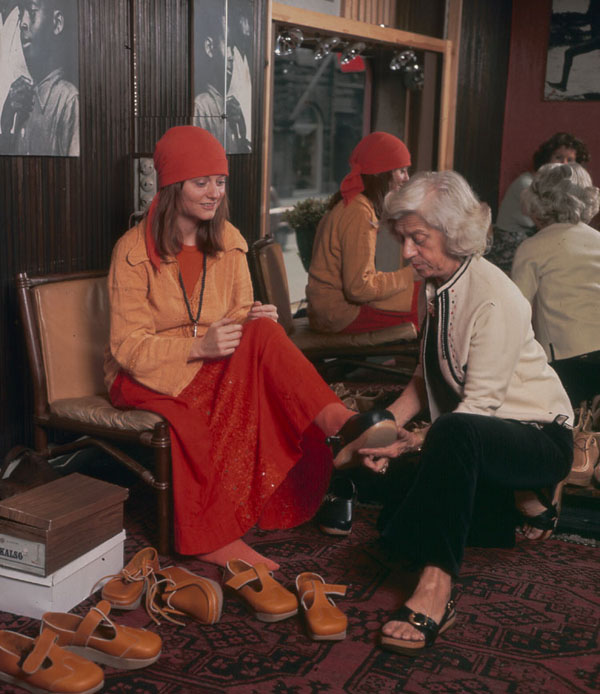
A little more detailed history courtesy of Earth Shoes:
It's a story that goes back more than 40 years...
Anne Kalsø was born in the Faroe Islands off Denmark in 1905. Her life was defined by a deep immersion in the study of yoga, and the fundamental belief that wellness principles needn't be reserved for just one aspect of an individual's life, but could be wholly integrated as part of an everyday existence.
Kalsø 's passion for yoga led her to study in Switzerland and eventually in Santos, Brazil. It was there, in 1957, that she observed the excellent posture of indigenous Brazilians, and the impressions left by their bare footprints as they walked through beach sand. She observed that the footprints laid were deeper in the heels than in the toes. This natural body position resonated with the thoughtful Kalsø . It echoed a formative yoga pose she knew well – Tadasana (the 'Mountain' pose).
As she herself emulated the pose of the native Brazilians, she noticed how her own posture improved, and how her breathing passages opened. She was inspired.
Returning to Denmark, Kalsø enlisted the help of a Portuguese shoe maker to begin what would become a 10-year process to design the original Kalsø Shoe. Although not a shoemaker by trade, Kalsø was deeply immersed in the process of shoe development -- even testing prototype models on long hikes that covered hundreds of miles. According to Kalsø , "it took numerous years of hard work before I reached the final form of my shoe that takes into consideration all the natural demands of the foot and body. It is only now that I know I have created something. It is no longer an idea in my mind, but is something that is thoroughly tested and proven."
Kalsø began selling her shoes from a modest storefront in Copenhagen. Those who discovered her shoes became passionate about their benefits. Many reported that the shoes helped ease chronic foot and body problems. Expectedly, people from around the world inquired about the shoes. But Kalsø insisted that they be experienced in-person prior to being worn.
Even with such interest and fervor, it was not until the mid-to-late 1960's that Kalsø entertained the idea of expansion – ultimately exploring retail beyond Denmark. And specifically in the United States.
April 1st, 1970 would mark the much-heralded opening of the first United States distribution point for Kalsø 's shoes. Coinciding with the first Earth Day, the name of the shoes - on the spot – was changed to "Kalsø Earth Shoes" and capitalized on the youthful movement and energy that defined the day. The trajectory of a wellness enterprise was underway. With much thanks and credit going to a Danish yoga instructor, a belief that wellness could be part of everyone's daily existence, and a simple shoe.
Kalsø Earth Shoes. Designed by Nature. Created by Kalsø.
Kalsø 's passion for yoga led her to study in Switzerland and eventually in Santos, Brazil. It was there, in 1957, that she observed the excellent posture of indigenous Brazilians, and the impressions left by their bare footprints as they walked through beach sand. She observed that the footprints laid were deeper in the heels than in the toes. This natural body position resonated with the thoughtful Kalsø . It echoed a formative yoga pose she knew well – Tadasana (the 'Mountain' pose).
As she herself emulated the pose of the native Brazilians, she noticed how her own posture improved, and how her breathing passages opened. She was inspired.
Returning to Denmark, Kalsø enlisted the help of a Portuguese shoe maker to begin what would become a 10-year process to design the original Kalsø Shoe. Although not a shoemaker by trade, Kalsø was deeply immersed in the process of shoe development -- even testing prototype models on long hikes that covered hundreds of miles. According to Kalsø , "it took numerous years of hard work before I reached the final form of my shoe that takes into consideration all the natural demands of the foot and body. It is only now that I know I have created something. It is no longer an idea in my mind, but is something that is thoroughly tested and proven."
Kalsø began selling her shoes from a modest storefront in Copenhagen. Those who discovered her shoes became passionate about their benefits. Many reported that the shoes helped ease chronic foot and body problems. Expectedly, people from around the world inquired about the shoes. But Kalsø insisted that they be experienced in-person prior to being worn.
Even with such interest and fervor, it was not until the mid-to-late 1960's that Kalsø entertained the idea of expansion – ultimately exploring retail beyond Denmark. And specifically in the United States.
April 1st, 1970 would mark the much-heralded opening of the first United States distribution point for Kalsø 's shoes. Coinciding with the first Earth Day, the name of the shoes - on the spot – was changed to "Kalsø Earth Shoes" and capitalized on the youthful movement and energy that defined the day. The trajectory of a wellness enterprise was underway. With much thanks and credit going to a Danish yoga instructor, a belief that wellness could be part of everyone's daily existence, and a simple shoe.
Kalsø Earth Shoes. Designed by Nature. Created by Kalsø.
1971The Kalsø Earth Shoe becomes the symbol of the 'casual revolution' started on college campuses around the country. Comfort and wellness inform the thinking of many progressive young people nationwide.
1975The Metropolitan Museum of Art places a Kalsø Earth Shoe in its permanent collection, securing its place as an icon that balances both form and function.
1990'sRestoring the name and its technologies, the Kalsø Earth Shoe is re-scoped and re-vitalized under a new company -- Earth, Inc. New fashion-forward styling and an expanded assortment - all of which features the Kalsø Earth Shoe's signature "negative heel" – provide the underpinnings of the new enterprise.
2003Kalsø Earth Shoe distribution expands into markets including Canada, Japan, Italy and Australia.
2008Reputable industry trade publication, Footwear Plus, honors Earth, Inc. with an "Excellence in Design" award.
1970The first Kalsø Earth Shoe store opens on East 17th Street in New York City, coinciding with the world's first celebration of Earth Day.
1974TIME Magazine publishes an extensive story on the Kalsø Earth Shoe. Demand soars. A full-page ad appears in national publications stating, "Please Be Patient. We're Making Our Shoes as Fast as We Can!"
1980'sUnable to keep up with demand, the Kalsø Earth Shoe in its first incarnation is no longer able to be sold at retail in the United States. Regional networks of consumer loyalists develop – petitioning to bring back the Kalsø Earth Shoe in some form.
2001The Kalsø Earth Shoe is officially re-launched. Noting its re-emergence, famed European shoe designer, Manolo Blahnik, remarks in a June TIME Magazine article "… the Kalsø Earth Shoe was the first shoe to ever make a social statement …"
2004Leading the sustainable footwear design evolution, Earth, Inc. becomes one of the first shoe manufacturers to introduce water-based adhesives throughout 100% of its line.
2010Leveraging the 40th Anniversary of Earth Day, Kalsø Earth Shoes celebrate their 40th birthday.
Thursday, February 21, 2013
Yoga Clothes
DownDog Boutique.com was founded in 2012 to provide an online outlet for smaller and unique Yoga Clothes manufacturers to offer an alternative to the mass produced Yoga Clothes of the giant corporations like Lululemon and Lucy.
At www.downdogboutique.com you can now find over 30 brands of Women's and Men's Yoga Clothes each with their own showcase. Many offer Organic Yoga Clothing and are often made in the USA by small workshops or individuals.
In addition to brand showcases our Yoga Clothes are grouped together to make certain types of Yoga clothing easier to find:
All Women's Yoga Tops
All Women's Yoga Pants
All Women's Yoga Dresses
All Women's Yoga Hoodies and Jackets
All Men's Yoga Shirts
All Men's Yoga Pants
At www.downdogboutique.com you can now find over 30 brands of Women's and Men's Yoga Clothes each with their own showcase. Many offer Organic Yoga Clothing and are often made in the USA by small workshops or individuals.
In addition to brand showcases our Yoga Clothes are grouped together to make certain types of Yoga clothing easier to find:
All Women's Yoga Tops
All Women's Yoga Pants
All Women's Yoga Dresses
All Women's Yoga Hoodies and Jackets
All Men's Yoga Shirts
All Men's Yoga Pants
Here are direct links to some of our most popular Yoga brands:
Women’s Yoga Clothing
Men’s Yoga Clothing
Chakras by Didi Men’s BelaBela by Bela Roogta Men’s Champion Sports Jala Clothing Men's
Eagle Warrior Mens Anjali Mens Minawear Mens
Eagle Warrior Mens Anjali Mens Minawear Mens
We welcome any comments questions or feedback
Monday, February 4, 2013
How to wrap an Anjali Silk Bracelet!

Hema was kind enough to create this guide to wrapping the Silk Bracelets. Follow the 6 easy steps below and enjoy!


See the whole collection of Silk Wraps here:
Friday, February 1, 2013
Cocoon Jewelry by Suzanne Balestri


About the Artist
Suzanne Balestri was an interior designer when she first began her explorations with fused glass. After taking a fused glass workshop for fun in 2006, it didn’t take long for her passion for the glass medium to grow. She soon began taking more in-depth courses in fused glass as well as jewelry design and fabrication at UC San Diego. In 2008, Suzanne began selling her work and participating in art shows.
These fused glass pieces of wearable art are handcrafted using a process originally developed by the Ancient Egyptians. Glass fusion requires carefully measuring, cutting and cleaning fusible glass before layering and assembling it into the desired conceptual design. The assembled unit is then placed into a kiln for several hours until it reaches 1475 degrees, the point at which the layered pieces melt into each other to become one piece. The kiln is then cooled over several hours, which anneals the glass to give it strength and durability. A good portion of the pieces come out of the kiln requiring further work (called “cold-working”) which includes grinding, drilling, sawing or sandblasting, depending on the what the desired final outcome of the piece is. After the piece is cold-worked, it requires another round through the kiln – at even slower heating and cooling rates – to “fire-polish” the piece.
Watch a video about Suzanne explaining the process:
View the Cocoon Jewelry collection at DownDog Boutique here:
Subscribe to:
Posts (Atom)